Knitting Patterns by Lyndell

Halter Neck Dress for Neo Blythes - here
Design your own Dress for Neo Blythes - here
Gum-Nut Hat for Neo Blythes - here

Who? What? eh?

This is the blog of a constant crafter - a 'showcase' for some of the things I make, some hints for crafting & recylcing - lots of photos and some words. I hope it will inspire.
Please Note: all photos are Copyright.


Showing posts with label green living. Show all posts

Wednesday, 26 April 2017

Environmental Footprint of Various Fibres used in Clothing - Part 4 the Ls

Part 4 - I to L of this alphabetical list but I can't think of any commonly used fibres that start with either I or J (if you can, please let me know and I'll add them to the list) & of K I can only think of Kevlar - again not commonly used.  
An attempt at a cradle-to-grave, un-biased evaluation of most of the fibres used in our clothing & crafting.  
Firstly to repeat a couple of important things (for more, see parts 1 & 2)
1.  When it comes to clothing - it isn't easy being green ...
2.  A great deal of the environmental impact of our clothing lies with the end user - that's you & me.  The person who buys, wears, washes, irons (?) mends, re-purposes, and ultimately decides when and how that garment is disposed of.  
3.  
Listing is alphabetical and it'll go over several posts 
4.  I will update it as I discover more informationI'm Australian so the info is sometimes Ozzie-centric
5.  I knit a lot (so I'll look at fibres often made into yarns but perhaps not so often found in commercial clothing)
6.  I've tried to cover all aspects 'from cradle to grave'.  

 --- --- --- ---
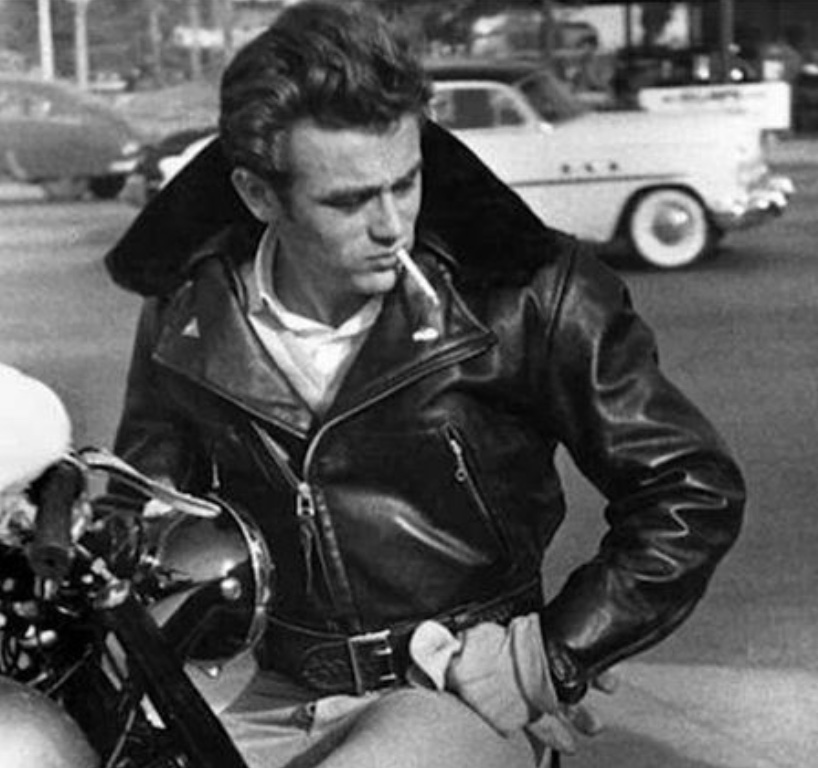


Iconic - his gloves are probably leather too


Leather - Strong, flexible and long lasting - leather has many uses.  

Growing it - Most leather is from cattle and there are environmental concerns about raising cattle.  It is an animal product and some people avoid all such - but if you are an eater of meat then leather is a by-product of your food.  Although most leather is from cattle, you can also find sheep leather (it is soft and slightly more fragile than cow) and pig leather, called pig skin (it has an interesting dimpled texture).  Other speciality leathers you might find include Deer Skin, Ostrich & Emu (fabulous dimpled textures on those), Barramundi fish leather (almost looks like the scales are still there).  

Processing it - Most of the environmental concerns with leather are from the pre-tanning and tanning processes.  Tanning permanently alters the protein structure of the skin and is necessary to make the leather durable and prevent decomposition ... it'll probably also change the colour.  Here is a bit of etymology for you - because it is from the tanning of leather that we get all those other uses of the word 'tan' - tan brown, tanning ourselves in the sun ...  and 'tan' comes from 'tannin' which in turn comes from an old German word for oak or fir trees, early sources of tannin.  Then there is the tannin in our cup of tea - and that is what will stain the crockery and makes tea a very useful dye.  But I digress ...

Before the skin is tanned it has to be prepared and this all gets rather nasty if you think about it!  First it is kept from 'going off' by being cured in salt or by freezing - then there are the 'Beamhouse Operations' to remove everything except the actual skin.  These processes are noxious and smelly - usually done on the outskirts of a town, traditionally near a river - but waste-products can get into the water supply ... 
I will run through some of the steps and try not to get too 'icky'!  
Soaking - to remove the salt and increase moisture.  To prevent bacteria etc, biocides and fungicides might be used.  Until 1980 in the US they could use mercury-based biocides - let us hope these are not used anywhere nowadays.
Liming & various processes to change the pH and remove hair and other unwanted stuff.  Various chemicals are used including sulfides and ammonia - in the past one of the processes involved animal dung !!!  
Finally the skin is Pickled with common salt and then sulphuric acid ... to produce more changes to the pH - then it can be tanned ...

Tanning - Most modern tanning is done with Chromium (III) sulphate which sounds scary, chromium is a heavy metal in the non rock-music sense.   Wikipedia assures me that "Chromium (III) compounds ... are less toxic than hexavalent chromium" but I'm not a chemist and anything Chromium sounds scary to me.
There is also Vegetable Tanning which uses the bark from trees as the source of tannin - those trees include chestnut, oak, tanoak (how did that tree get its name?) mangrove and wattle.  


Coat of Arms
Yes my fellow Australians ... the Golden Wattle - our National Flower is a wonderful source of tannin (as are other wattle trees but the Golden is the best).  In the early 1980s I lived near a tannery that used wattle bark and I can truthfully say that it didn't smell - though perhaps that was because all the really noxious pre-processing was done elsewhere. 

Unfortunately, vegetable tanned leather is not as flexible as that tanned with Chromium.

How should we look after it - and some of this depends on how the leather has been used.  Leather can get stiff and it can get mildew or mould - so keep in a dry environment and use a good leather conditioning oil or 'wax' - keep your leather shoes & boots nicely polished.  Think of polishing shoes not as a chore but as a lovely form of meditation.

What happens when it does go into land-fill? -  not a nice thought for that expensive leather sofa but leather will biodegrade; it takes a while but it will happen.

Leather from Fungus or Slime Mould or Pineapple Leaves (Pinatex) -  Lots of very clever people are working to create products that look and behave like leather - sometimes this is called 'victimless leather'.  Early stages, but how wonderful if something as useful and adaptable as leather from a cow could be made (without massive environmental impact) from something as easy to grow as a slime mould.  Looking forward to seeing progress and more information about this. 

I do hope we can produce a good alternative leather but it needs to be environmentally friendly in every step of the process.

Leatherette  - another name for PVC.  This and other faux man-made leathers will be listed separately.

Linen - This fibre is less used now than in the past - cotton has taken the place of linen for many garments and for things such as sheets, tea towels, tablecloths ... all those things we refer to sometimes as 'household linen'.


A flax crop in flower - in Belgium
What is it?  Linen is a plant fibre and the plant is called flax which is confusing!  The cultivated flax plant (Linum usitatissimum yes, that means 'most useful') no longer exists in a wild form.   It is a very useful plant; not only do we get fibre from the stems but the seeds are crushed to make Linseed Oil and are edible, turning up in seeded bread and health foods - it is also quite pretty with dainty little blue flowers.

Humans have used flax fibre for at least 30,000 years.  The Egyptian mummies were wrapped in very fine linen, the Romans used it for their sails & flax fibre can be used to make paper.  Flax fibre is 2 to 3 times stronger than cotton fibre, it is also naturally smooth and straight, however, linen fabric is stiffer to handle and more easily wrinkled - linen garments need a lot of ironing though the 'naturally crumpled' look has a certain charm.

Producing / Growing it - Flax likes good soil, there aren't many pests that eat it but flax doesn't compete with weeds well.  The crop is harvested after 80 to 100 days - after flowering but before the seeds have set for the best quality fibre, but the seeds are valuable too.

Processing it  - There are a lot of similarities in the processing of hemp fibre and flax - both are retted & scutched to remove the unwanted harder and sticky parts of the stem.  The exact processes vary from country to country and depending on the intensity of cropping.  A lot of high quality flax / linen comes from northern France and Belgium where the process is quite mechanised but you can also find a lot of interesting clips on YouTube from re-enactors & historical places in Ireland and the US etc.
Harvesting flax in Belgium
The plants are usually pulled up roots and all for maximum length of fibre and then they are left in bundles in the field to ret naturally in the sun, dew and rain.  Retting is really a controlled rotting (those words are similar!).

Retting can also be done in water - but it will pollute that water and it smells.

When dry again, the retted stalks (sometimes called straw) undergoes breaking and scutching (similar processes) to remove the woody unwanted parts of the stem from the lovely flaxen fibre inside ...  and yes, it does look like blonde 'flaxen' hair.  In the US the terminology seems a little different e.g. they use a 'brake' to break up the hard part of the stem.  All this can be done mechanically of course and I've found this wonderful YouTube of a old Scutch Mill in Ulster - fabulous Irish accent too.

Aren't the names of these processes rather wonderful?   In the process of turning flax into linen we've retting, breaking, scutching and then heckling or hackling.  Yes, 'heckling' as in - teasing and interrupting a speaker ... does originate with the heckling and teasing of fibre.  Also, scutching and heckling are unpleasant hot & dusty jobs ... hecklers had "a reputation as the most radical and belligerent element in the workforce.  In the heckling factory, one heckler would read out the day's news while the others worked, to the accompaniment of interruptions and furious debate."  (Wikipedia here)

an early American Hackle 
But back to the flax - and this heckling / hackling is to pull the fibres through a metal comb (and now we know the derivation of the old saying "to get your hackles up").  Again, this process has been mechanised which isn't so picturesque but finally there should be lovely long, silky, white to yellow, flax fibres and the short courser fibres left behind which are called Tow.  Tow can be used to make twine, fishing nets, ropes, and in paper, building products or for fuel.


And now the Flax can be spun and woven into a linen fabric.
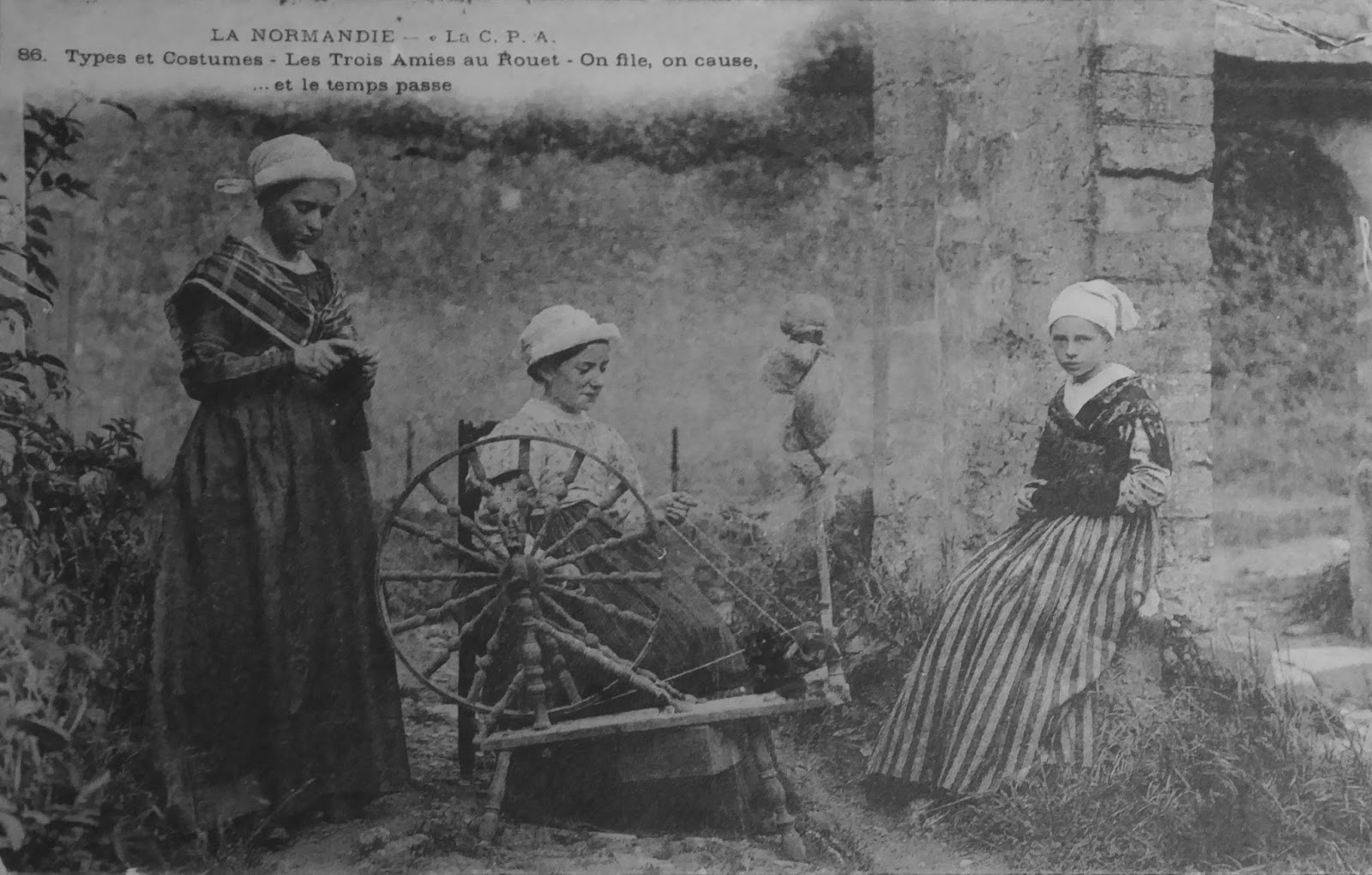
Postcard from very early 1900s -
the lady on the left is knitting a sock, the lady in the middle is spinning flax


As can be seen from this French postcard - spinning flax has always been a bit different to spinning wool.  The fibre is held on a distaff and often the wheel is turned with the hand ... rather than by foot pedals. Not apparent here but usually the fibre is kept slightly wet while it is spun - to keep it smooth and for strength (flax / linen is much stronger when wet than when dry) so the spinning wheels often had little wooden cups or at least a cup holder.  Of course, modern flax / linen fabric is spun and woven by large machines and in the spinning mills the fibre is wet so those factories are quite humid.


Caring for Linen Clothing - Linen is strong and durable, very absorbent and stronger when wet than dry/  Linen makes great clothes for hot, humid weather partly because it doesn't cling to you as much as cotton does.  Go with the naturally crumpled look rather than using lots of electricity (and your sanity) ironing it all the time.

Other Thoughts - This is more about the ethics of our clothing than the environmental impact but processing flax into linen is still very labour intensive - that lovely flaxen fibre is quite fragile.  If you can, check that the linen is manufactured in a country where workers get a living wage and there are good industrial practices to protect the workers' health etc.

Another thought - because I'm trying to learn how to made lace by hand (bobbin lace). The regions where lace was made were often the same regions that made linen (and some still do) because the lace was made from very fine linen thread - often much finer than we can find nowadays (and we usually use cotton thread now).

Burning and Biodegrading - Linen / flax burns and biodegrades just like all the other plant based fibres.

Lycra - see Elastane in part 3.

Lyocell - see Rayon when I get to the Rs in this list.

Tuesday, 27 December 2016

Environmental Footprint of Various Fibres used in Clothing - Part 3

Part 3 -  D to H of this alphabetical list;  An attempt at a cradle-to-grave, un-biased evaluation of most of the fibres used in our clothing & crafting.  

Firstly to repeat a couple of important things (for more, see parts 1 & 2)
1.  When it comes to clothing - it isn't easy being green ...
2.  A great deal of the environmental impact of our clothing lies with the end user - that's you & me.  The person who buys, wears, washes, irons (?) mends, re-purposes, and ultimately decides when and how that garment is disposed of.  

Listing is alphabetical and it'll go over several posts
I will update it as I discover more information
I'm Australian so the info is sometimes Ozzie-centric
I knit a lot (so I'll look at fibres often made into yarns but perhaps not so often found in commercial clothing)
I've tried to cover all aspects 'from cradle to grave'.  

 --- --- --- ---

Dacron - see Nylon later in this on-going list, when I get to the letter N


Elastane / Spandex / Lycra - this is the stuff that makes stretch fabrics stretchy and about 80% of new clothing contains elastane threads - it is in:

Just love the "ActiveWear" parody - YouTube
Activewear
Costumes
Dance-wear
Gloves
Hosiery - socks, stockings, tights
Leggins & Jeggins
Orthopaedic braces
Skinny jeans
Sports clothes
Surgical stockings
Swimwear
Underwear ... ... ...

Without elastic and elastic threads we would have underwear that buttoned on or laced up - I don't think we want to return to that but let's look at what all this stretchy stuff is.

What is it? -  Good ole' Wikipedia tells us that it is a "polyester-polyurethane copolymer ... invented in 1958 by ... Joseph Shivers at DuPont "  so obviously man-made and basically a plastic.  The word 'plastic' is a great catch-all for non-chemists like myself but most plastics are derived from petrochemicals and most don't biodegrade or they do so very slowly or they break down into tiny - micro - bits of plastic.  Unfortunately, most commonly used plastics are also unstable ... so although they sit about for ages in land-fill and our oceans they often don't last very well fulfilling the original purpose for which they were made.  I'm thinking here of those early Barbie dolls that go all sticky and disintegrate, all the plastic kitchen bowls that have cracked with use ... and of course, all those bits of elastic in clothing that stopped being elastic.

How should we look after it? - The elastane threads are usually woven or knitted with other fibres but it is often the elastane that 'goes' first and our stretch-wear stops 'returning' after being stretched.  To keep elastane and elastics being elastic:

  • avoid chemicals - deodorants aren't good but if you are being active in your active wear ...  ...   laundry powders and fabric conditioners are the other common sources of chemical overload.  
  • avoid heat - I doubt you iron your swimsuit or that superman costume  but don't tumble dry anything with elastic thread.  Line drying is always best for our clothes but that said - UV is bad for plastic
  • avoid UV - so try to dry in the shade.

What happens when it does go into land-fill? - I suspect that as with a lot of plastics, those elastic threads break into tiny little bits, still there but hard to see.

A bit of Trivia - the name 'Spandex' is an anagram of 'Expands'   :-)

Flax - see Linen later on in this alphabetical list

Hemp - Yes, we are talking about cannabis but the plants used for their fibre have been bred to be low in THC ... so smoking a hemp T-shirt is quite pointless !!

Hemp stem showing the bast fibres and core 

What is it?  Hemp fibre has been used to make fabric and paper for thousands of years.  It is easy and very fast to grow, the fibres are long and thus very strong, hemp fibres don't stretch readily so hemp fabric holds its shape and hemp is naturally mold & rot resistant.

Hemp fabric was traditionally used when strength & durability were required - sails were made of it and the word 'canvas' comes from 'cannabis'.  During the Californian gold-rush, the miners needed trousers that were tough - the story goes that Levi Strauss started providing them with trousers made from light weight canvas ... made of hemp fibre ... the first 'jeans'.

Producing / Growing it - Industrial hemp grows easily to a height of 4m, it likes warmth and good soil (but needs less fertiliser than corn) hemp doesn't need pesticides or herbicides (hemp is planted quite densely so it'll out-compete any weeds).  A hemp crop requires about 14 times less water than cotton.  Industrial hemp captures large quantities of carbon and the plants mature in 3 to 4 months.  "Hemp benefits crops grown after it ... high weed suppression, soil loosening by the large hemp root system and the positive effect on soil ... it can also be grown several years in a row in the same fields"    (all this info from Wikipedia)

France produces more that 70% of the world's hemp fibre.

Fileuses de Chanvre - spinners of hemp - from the early 1900s
and note the foot warmer under those sabots
Processing it - There are some lovely words in the processing of hemp and other plant fibres ... after harvesting the hemp is retted then there is scrutching and something called a decorticator.  
Retting uses water to dissolve or rot away cells and pectins surrounding the bast fibres ... hemp can be 'dew retted' by simply leaving it to lie in the field for a few weeks, or it can be 'tank retted' in concrete vats, this takes 4 to 6 days and the waste water can be used as liquid fertiliser.
Scrutching is breaking of the retted 'straw' (the stems) to further separate those desirable bast fibres from the woody core ...  
I took these photos in the Museum of Popular Tradition in Offida, Italy - please excuse the quality, this was a small crowded room and this Gramola was long, being made from the trunk of a tree ... 


But you can see rather clearly how it worked ... personally, I'd not want to get my arm in there!  Not sure if that fibre draped over it is hemp or a raffia - it was a bit long to be flax but the spinning wheel is the sort used for spinning flax.

The Retting and Scrutching processes are basically the same for Hemp fibre and Flax.

A decorticator is a mechanical scrutcher - that breaks the stem and does the separation as well.  There are different types of decorticators for other fibres and for different grains, nuts and wood - but it seems that the first decorticator was made for hemp - in 1861 by a farmer from Bologna -  only he called it a "scavezzatrice".

From there the hemp fibre can be spun much the same as flax / linen ... indeed all the non-industrial photographic references I can find (such as that postcard from 'picturesque Auvergne') show the same arrangements for distaff, drop spindle or spinning wheel for flax and for hemp.

Other Thoughts - All parts of the industrial hemp plant is useful - the fibre makes great rope and paper, the inner core can be used to strengthen building materials and plastic car panels, it can be used as insulation, animal bedding and as a biofuel, the oily seeds can be used medicinally, as animal and bird feed, in cosmetics and paints.   75 to 90% of all paper was made with hemp fiber until 1883 and it is ideal for paper-making; it grows much faster than trees, the fiber is longer & stronger, it is naturally cream coloured and low in lignin - so requires far fewer nasty chemicals to process and the resulting paper doesn't yellow and is much stronger than paper made from trees.

Caring for Hemp clothing - Hemp fabric is strong and durable, it is absorbent and is actually stronger wet than dry.  It handles extreme washing temperatures and hot ironing, but bleaching can damage hemp.  It is naturally mothproof.  On a personal note - my hubby darling's hemp T-shirts last a great deal longer than the cotton ones.

Burning and Biodegrading - Hemp fibre burns and biodegrades just like all the other plant based fibres.

The painted ceiling of an arcade / portico in Bologna showing hemp leaves,
spinning equipment and a lady weaving

Wednesday, 18 April 2012

Update a Pattern Workshop

This coming Saturday (20th April) I'm going to facilitate another UpCycling Workshop at the Green Living Centre on King Street Newtown.  I think it is fully booked but there is a wait-list and if this workshop is successful, the centre will probably run it again.   Here is a link to more info and the wait-list. 

This workshop will be all about updating commercial sewing patterns. 

There is nothing quite as dated and out-of-style as something that has recently been very fashionable. 

Out of date & out of style sewing patterns are really cheap in Op Shops and they lurk in the cupboards of most home dress-makers.  What to do with them?  I mean apart from laugh at those enormous shoulders & that dreadful styling - or go all nostalgic because mum used to wear something just like that  ...

Well - let's look at one of those patterns again.
The flipped-out Farrah Fawcett hairstyles effectively date this to the late 70s and look at the price - $3.50!

Another good reason to re-use old sewing patterns is the cost of new ones!

But these styles are old enough to be fashionable again.  Paper-bag waists are totally in fashion once more and that little cap-sleeve top is quite cute esp. if done in a plain fabric.  However, this pattern is a size 8 and that is a 1970s size 8 ! Some basic grading can bring this pattern up to a modern size 10  or 12.

What about some of the more extreme styles like this -

The skirt is a basic straight style with a little split at the back - a classic.  But the top is a different matter - massive shoulders, close plain neck-line, a long peplum & buttons makes this a very dated 80s look.

But - here is a quick idea - badly sketched (sorry). 

Scoop out the neck, make the shoulder line more natural, delete the buttons & peplum and we could use this pattern to make a nice batwing sleeved top.  Very now!


Here is another 80s pattern - a rather Princess Diana inspired look here - all pretty and demure with the lace collar, thin belt and long skirt length.  The shoulders are big but a cross over dress is always flattering and easy to wear.

Again, my quick sketching is not very skillful but if we reduce those shoulders, give the dress slimmer sleeves,  add flair to the skirt and make it a better length - we could make the dress button up and instead of lace put on a floaty bias fabric collar / frill.  Far more wearable.  

This is the sort of thing we'll be doing this Saturday - how to look at our out-of-date sewing patterns with fresh eyes and how to make some alterations to the patterns so we can make fashionable garments that fit.