Knitting Patterns by Lyndell

Halter Neck Dress for Neo Blythes - here
Design your own Dress for Neo Blythes - here
Gum-Nut Hat for Neo Blythes - here

Who? What? eh?

This is the blog of a constant crafter - a 'showcase' for some of the things I make, some hints for crafting & recylcing - lots of photos and some words. I hope it will inspire.
Please Note: all photos are Copyright.


Showing posts with label fibre and environment. Show all posts

Tuesday, 5 December 2017

Environmental Footprint of Various Fibres used in Clothing - Part 5 M, N & O

Part 5 - M, N & O of this alphabetical list. An attempt at a cradle-to-grave, un-biased evaluation of most of the fibres used in our clothing and crafting.  
Firstly to repeat a couple of important things (for more, see parts 1 & 2)
1.  When it comes to clothing - it isn't easy being green ...
2.  A great deal of the environmental impact of our clothing lies with the end user - that's you & me.  The person who buys, wears, washes, irons (?) mends, re-purposes, and ultimately decides when and how that garment is disposed of
3.  Listing is alphabetical and it'll go over several posts 
4.  I will update it as I discover more information - I'm Australian so the info is sometimes Ozzie-centric
5.  I knit a lot (so I'll look at fibres often made into yarns but perhaps not so often found in commercial clothing)
6.  I've tried to cover all aspects 'from cradle to grave'.  
 --- --- --- ---


Mercerised Cotton - Cotton treated by dipping into a strong alkaline (usually caustic soda) to give the thread a lustrous appearance, improved dye absorption, greater strength and a smoother, softer feel when handled.  Sometimes the thread is also singed to remove stray fibres.

From an environmental point of view, improved dye absorption is a good thing as it means less (usually chemical) dyestuff to produce the colour but where does the alkaline go and if the thread is also singed - this is done by passing it over a flame ... so that means fossil fuel consumption etc


Microfiber / Microfibre - synthetic fiber finer than one denier ... extremely fine, really extremely fine.  Microfibre is very fine polyester, polyamide (this means nylon) or a mix of man-made synthetic fibres.  As a non-scientist / non-industrial-chemist I think of synthetic fibres as basically being plastics made from petrochemicals. 

I'll go into greater depth when I get to those man-made fibres - but I think most of us familiar with the environmental problems of polyester & nylon.  Fabrics that don't really biodegrade but do shed tiny particles of plastic when washed - micro-plastics which are now causing great environmental concern  and plastic fibres are the most common form of micro-plastic pollution.  

From the Global to the Personal - Microfibre sounds far more sophisticated than Polyester but when very fine threads of some-form-of-plastic are woven snugly together to made a fabric, that resulting fabric lacks breathability to an even greater degree than the older styles of Polyester fabric.  It isn't very pleasant to wear and can result in your becoming less than pleasant to be around.

The synthetic fabrics don't 'breathe' and they don't biodegrade but they do burn ... and melt into sticky very hot goo ... well it is melted plastic ... not nice if you happen to be wearing it !  

   
Minki - I'm including this because I'm seeing a lot of products labelled 'Minki' - so what is it?  


Mink - not minki
In a word - 100% Polyester.  Made into a thick 'fleece' fabric or low-pile faux fur.  It has nothing to do with minks or their fur.    

It is often made into blankets - - -  


Rant Alert - I've tried to maintain a distance and not assert too many opinions in this series of Blog Posts - BUT - polyester blankets ? 

Minki blankets are often sold as suitable for children !!

Polyester doesn't 'breathe' and it is a fire-hazard.  In the unfortunate event of a fire, polyester burns fiercely (like the petroleum product it is) and then goes to a black, sticky and Very Hot goo which sticks to things and emits heat (just imagine what that does on skin).
OK - Rant Over. 


Modacrylic - a form of acrylic.  Modacrylic is flame-retardant but it is prone to pilling so needs careful laundering.  It is used for protective clothing, fake fur fabrics, soft toys and wigs.


Modal - when it is not a misspelling of 'model' this is yet another type of Rayon.  Rayon will be addressed in full when I get to the letter R but Rayon is reconstituted cellulose - basically it starts as plants which are turned into a cellulose soup - and then chemically hardened and extruded into fibres.    In the case of Modal the plant material should come from plantation beech trees.

The European Beech 

Modal was developed by an Austrian company called Lenzing - Lenzing Modal is made from sustainably managed beech tree plantations in Europe and their process was developed to minimise environmental impacts by recovering and reusing the chemicals used in the process.  

However, not all garments labelled 'Modal' are made of this more environmentally friendly fibre.  Some manufacturers have been accused of forest destruction in Indonesia and garments labelled 'Modal' and manufactured (sewn) in China are often made with Indonesian Modal.    

So - the advice is to take care when choosing things labelled Modal and preference garments manufactured in Europe over those made in Asia.


Mohair -  Mohair comes from Angora Goats but Angora comes from Angora Rabbits - it would be less confusing if we renamed the goats but both animals are named for Ankara in Turkey.  Some people think of mohair as scratchy and in the past it often was; but when mohair has come from well-fed young animals - then it should be soft, with a lovely 'halo' of fluffiness and slightly sheeny.
Mohair on the hoof


Mohair is a long fibre, lustrous and almost without scales (the microscopic barbs that can make wool feel scratchy) - the lack of scales also makes mohair difficult to felt / full / shrink (all 3 being basically the same process).  Mohair is regarded as a luxury fibre and is used for knitting yarns, it is woven into top-end suit and coat fabrics (often blended with wool) and is made into fur fabrics for the more expensive soft toys - in the past it was used for dolls' hair and still is for OOAK and customised dolls.

Growing it - Angoras are smaller than standard goats and they are not as tough; good feed is needed especially if you want nice fleece from them.  In Australia the feed and water requirements are about the same as for sheep - with the same considerations about hard hooves doing soil damage.  Goats will also devour leaves and bark from trees and have a higher reach than sheep.

Angora goats are usually shorn twice a year and can produce 5 to 8 kg of fleece per annum.  Today, South Africa is the world's largest producer of mohair.

Processing it - Mohair grows in uniform locks and it is a single-coat - so there are no long, coarse guard hairs which have to be separated from the desirable fibre.  The fleece does need cleaning (scouring - with water and strong detergents) but this is easier than with sheep's wool as there is much less lanolin.  Mohair takes dye very well - so it requires less dyestuff than some other fibres.  

Spinning & weaving mohair is done very similarly to other natural animal fibres.

Caring for it - This is also similar to other animal fibres such as wool or alpaca.  Mohair should be washed with care and as few chemicals as you can manage; keep in mind that mohair is often blended with wool which can shrink.  Store safe from insect pests by using a scent disruptor (I've found that ground white pepper is very effective, also it is cheap & long lasting). 

Burning and Biodegrading - Like wool, mohair is flame resistant and, being natural, it will biodegrade in landfill.


Nylon - A synthetic polymer - a smooth thermoplastic that can be melt-processed into fibres, films and shapes.   Wallace Carothers working for the Du Pont company developed nylon during the 1930s - the first commercial use being for toothbrush bristles in 1938, closely followed by women's stockings ... then during World War II most nylon production went to make parachutes - for the canopy and the cords.


Rationing helped to make nylon stockings immensely popular but after the war nylon Du Pont cleverly marketed Nylon for other uses including nylon fabrics for lingerie and fashionable clothes.  All those filmy 50s frocks (nylon) with big bouffant skirts - held out by tulle petticoats (nylon).


The Name - Unfortunately the story that 'Nylon' stands for New York & London is an urban myth.  This is what Wikipedia says 


Processing it  - Nylons (there are many forms) are plastics made from petrochemicals (from coal or petrol)  though it is possible to make a type of nylon from castor oil (that's from a plant) ... Du Pont hold that patent too and they call it Zytel.  

Nylon is very useful  - it is strong, durable, resistant to insects and molds / fungi (because it is synthetic) and it is fast drying (because it is non-absorbent).  Nylon is used for umbrellas, raincoats, flags, strings for musical instruments, fishing lines, machine gears, broom bristles, sausage skins ... all sorts of things - even Kevlar is a variety of Nylon.  However, for clothing Nylon is no-longer so popular as we have problems with that non-absorbency.

These days we aren't likely to find a garment tag that says 'Nylon' (except on something vintage)  but you might find Polyamid or Polyamide ... this is a renaming of nylon.  Also, nowadays nylon (sorry, polyamide) is usually blended with other fibres to make it less 'sweaty'.

Caring for it - Although nylon is a fairly tough plastic - it can be melted (so don't iron it or tumble dry it)  and it can be damaged by some chemicals.  If you do own vintage Nylon - especially if it is white - avoid drying it in direct sunlight and do not use chlorine or chloride bleach on it as these things will cause a white nylon to yellow.

Burning and Biodegrading - As for all the other synthetic fibres that are based on petrochemicals, nylon will melt, it'll burn and go to sticky goo that might stick to skin.  As for the other 'plastic' fibres, nylon doesn't biodegrade readily - though there is a bacteria that eats it - more Wikipedia here.  


Orlon - see Acrylic - Orlon was an early trademark name for acrylic.  Orlon was also used for knitting yarn and like most acrylic yarns it pilled badly.


Wednesday, 26 April 2017

Environmental Footprint of Various Fibres used in Clothing - Part 4 the Ls

Part 4 - I to L of this alphabetical list but I can't think of any commonly used fibres that start with either I or J (if you can, please let me know and I'll add them to the list) & of K I can only think of Kevlar - again not commonly used.  
An attempt at a cradle-to-grave, un-biased evaluation of most of the fibres used in our clothing & crafting.  
Firstly to repeat a couple of important things (for more, see parts 1 & 2)
1.  When it comes to clothing - it isn't easy being green ...
2.  A great deal of the environmental impact of our clothing lies with the end user - that's you & me.  The person who buys, wears, washes, irons (?) mends, re-purposes, and ultimately decides when and how that garment is disposed of.  
3.  
Listing is alphabetical and it'll go over several posts 
4.  I will update it as I discover more informationI'm Australian so the info is sometimes Ozzie-centric
5.  I knit a lot (so I'll look at fibres often made into yarns but perhaps not so often found in commercial clothing)
6.  I've tried to cover all aspects 'from cradle to grave'.  

 --- --- --- ---


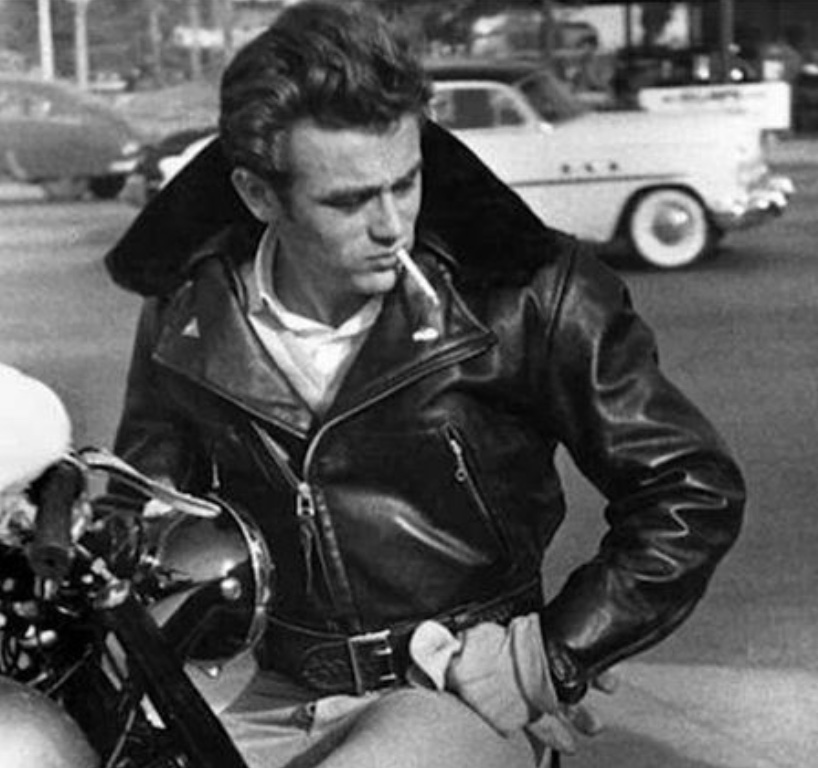
Iconic - his gloves are probably leather too


Leather - Strong, flexible and long lasting - leather has many uses.  

Growing it - Most leather is from cattle and there are environmental concerns about raising cattle.  It is an animal product and some people avoid all such - but if you are an eater of meat then leather is a by-product of your food.  Although most leather is from cattle, you can also find sheep leather (it is soft and slightly more fragile than cow) and pig leather, called pig skin (it has an interesting dimpled texture).  Other speciality leathers you might find include Deer Skin, Ostrich & Emu (fabulous dimpled textures on those), Barramundi fish leather (almost looks like the scales are still there).  

Processing it - Most of the environmental concerns with leather are from the pre-tanning and tanning processes.  Tanning permanently alters the protein structure of the skin and is necessary to make the leather durable and prevent decomposition ... it'll probably also change the colour.  Here is a bit of etymology for you - because it is from the tanning of leather that we get all those other uses of the word 'tan' - tan brown, tanning ourselves in the sun ...  and 'tan' comes from 'tannin' which in turn comes from an old German word for oak or fir trees, early sources of tannin.  Then there is the tannin in our cup of tea - and that is what will stain the crockery and makes tea a very useful dye.  But I digress ...

Before the skin is tanned it has to be prepared and this all gets rather nasty if you think about it!  First it is kept from 'going off' by being cured in salt or by freezing - then there are the 'Beamhouse Operations' to remove everything except the actual skin.  These processes are noxious and smelly - usually done on the outskirts of a town, traditionally near a river - but waste-products can get into the water supply ... 
I will run through some of the steps and try not to get too 'icky'!  
Soaking - to remove the salt and increase moisture.  To prevent bacteria etc, biocides and fungicides might be used.  Until 1980 in the US they could use mercury-based biocides - let us hope these are not used anywhere nowadays.
Liming & various processes to change the pH and remove hair and other unwanted stuff.  Various chemicals are used including sulfides and ammonia - in the past one of the processes involved animal dung !!!  
Finally the skin is Pickled with common salt and then sulphuric acid ... to produce more changes to the pH - then it can be tanned ...

Tanning - Most modern tanning is done with Chromium (III) sulphate which sounds scary, chromium is a heavy metal in the non rock-music sense.   Wikipedia assures me that "Chromium (III) compounds ... are less toxic than hexavalent chromium" but I'm not a chemist and anything Chromium sounds scary to me.
There is also Vegetable Tanning which uses the bark from trees as the source of tannin - those trees include chestnut, oak, tanoak (how did that tree get its name?) mangrove and wattle.  


Coat of Arms
Yes my fellow Australians ... the Golden Wattle - our National Flower is a wonderful source of tannin (as are other wattle trees but the Golden is the best).  In the early 1980s I lived near a tannery that used wattle bark and I can truthfully say that it didn't smell - though perhaps that was because all the really noxious pre-processing was done elsewhere. 

Unfortunately, vegetable tanned leather is not as flexible as that tanned with Chromium.

How should we look after it - and some of this depends on how the leather has been used.  Leather can get stiff and it can get mildew or mould - so keep in a dry environment and use a good leather conditioning oil or 'wax' - keep your leather shoes & boots nicely polished.  Think of polishing shoes not as a chore but as a lovely form of meditation.

What happens when it does go into land-fill? -  not a nice thought for that expensive leather sofa but leather will biodegrade; it takes a while but it will happen.

Leather from Fungus or Slime Mould or Pineapple Leaves (Pinatex) -  Lots of very clever people are working to create products that look and behave like leather - sometimes this is called 'victimless leather'.  Early stages, but how wonderful if something as useful and adaptable as leather from a cow could be made (without massive environmental impact) from something as easy to grow as a slime mould.  Looking forward to seeing progress and more information about this. 

I do hope we can produce a good alternative leather but it needs to be environmentally friendly in every step of the process.

Leatherette  - another name for PVC.  This and other faux man-made leathers will be listed separately.

Linen - This fibre is less used now than in the past - cotton has taken the place of linen for many garments and for things such as sheets, tea towels, tablecloths ... all those things we refer to sometimes as 'household linen'.


A flax crop in flower - in Belgium
What is it?  Linen is a plant fibre and the plant is called flax which is confusing!  The cultivated flax plant (Linum usitatissimum yes, that means 'most useful') no longer exists in a wild form.   It is a very useful plant; not only do we get fibre from the stems but the seeds are crushed to make Linseed Oil and are edible, turning up in seeded bread and health foods - it is also quite pretty with dainty little blue flowers.

Humans have used flax fibre for at least 30,000 years.  The Egyptian mummies were wrapped in very fine linen, the Romans used it for their sails & flax fibre can be used to make paper.  Flax fibre is 2 to 3 times stronger than cotton fibre, it is also naturally smooth and straight, however, linen fabric is stiffer to handle and more easily wrinkled - linen garments need a lot of ironing though the 'naturally crumpled' look has a certain charm.

Producing / Growing it - Flax likes good soil, there aren't many pests that eat it but flax doesn't compete with weeds well.  The crop is harvested after 80 to 100 days - after flowering but before the seeds have set for the best quality fibre, but the seeds are valuable too.

Processing it  - There are a lot of similarities in the processing of hemp fibre and flax - both are retted & scutched to remove the unwanted harder and sticky parts of the stem.  The exact processes vary from country to country and depending on the intensity of cropping.  A lot of high quality flax / linen comes from northern France and Belgium where the process is quite mechanised but you can also find a lot of interesting clips on YouTube from re-enactors & historical places in Ireland and the US etc.
Harvesting flax in Belgium
The plants are usually pulled up roots and all for maximum length of fibre and then they are left in bundles in the field to ret naturally in the sun, dew and rain.  Retting is really a controlled rotting (those words are similar!).

Retting can also be done in water - but it will pollute that water and it smells.

When dry again, the retted stalks (sometimes called straw) undergoes breaking and scutching (similar processes) to remove the woody unwanted parts of the stem from the lovely flaxen fibre inside ...  and yes, it does look like blonde 'flaxen' hair.  In the US the terminology seems a little different e.g. they use a 'brake' to break up the hard part of the stem.  All this can be done mechanically of course and I've found this wonderful YouTube of a old Scutch Mill in Ulster - fabulous Irish accent too.

Aren't the names of these processes rather wonderful?   In the process of turning flax into linen we've retting, breaking, scutching and then heckling or hackling.  Yes, 'heckling' as in - teasing and interrupting a speaker ... does originate with the heckling and teasing of fibre.  Also, scutching and heckling are unpleasant hot & dusty jobs ... hecklers had "a reputation as the most radical and belligerent element in the workforce.  In the heckling factory, one heckler would read out the day's news while the others worked, to the accompaniment of interruptions and furious debate."  (Wikipedia here)

an early American Hackle 
But back to the flax - and this heckling / hackling is to pull the fibres through a metal comb (and now we know the derivation of the old saying "to get your hackles up").  Again, this process has been mechanised which isn't so picturesque but finally there should be lovely long, silky, white to yellow, flax fibres and the short courser fibres left behind which are called Tow.  Tow can be used to make twine, fishing nets, ropes, and in paper, building products or for fuel.


And now the Flax can be spun and woven into a linen fabric.
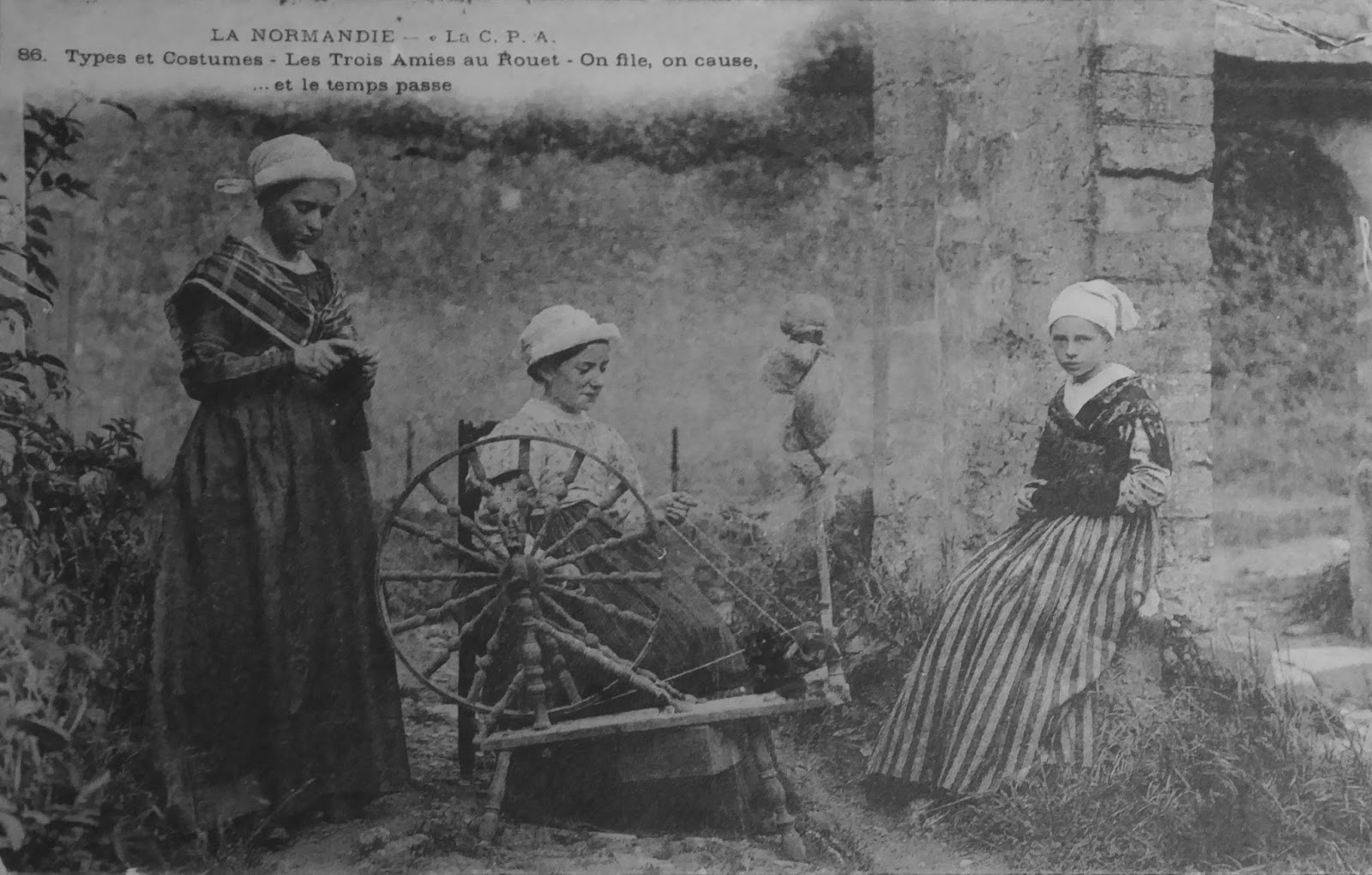
Postcard from very early 1900s -
the lady on the left is knitting a sock, the lady in the middle is spinning flax


As can be seen from this French postcard - spinning flax has always been a bit different to spinning wool.  The fibre is held on a distaff and often the wheel is turned with the hand ... rather than by foot pedals. Not apparent here but usually the fibre is kept slightly wet while it is spun - to keep it smooth and for strength (flax / linen is much stronger when wet than when dry) so the spinning wheels often had little wooden cups or at least a cup holder.  Of course, modern flax / linen fabric is spun and woven by large machines and in the spinning mills the fibre is wet so those factories are quite humid.


Caring for Linen Clothing - Linen is strong and durable, very absorbent and stronger when wet than dry/  Linen makes great clothes for hot, humid weather partly because it doesn't cling to you as much as cotton does.  Go with the naturally crumpled look rather than using lots of electricity (and your sanity) ironing it all the time.

Other Thoughts - This is more about the ethics of our clothing than the environmental impact but processing flax into linen is still very labour intensive - that lovely flaxen fibre is quite fragile.  If you can, check that the linen is manufactured in a country where workers get a living wage and there are good industrial practices to protect the workers' health etc.

Another thought - because I'm trying to learn how to made lace by hand (bobbin lace). The regions where lace was made were often the same regions that made linen (and some still do) because the lace was made from very fine linen thread - often much finer than we can find nowadays (and we usually use cotton thread now).

Burning and Biodegrading - Linen / flax burns and biodegrades just like all the other plant based fibres.

Lycra - see Elastane in part 3.

Lyocell - see Rayon when I get to the Rs in this list.

Thursday, 24 November 2016

Environmental Footprint of Various Fibres used in Clothing - Part 2

Part 2 -  B & C of this alphabetical list;  An attempt at a cradle-to-grave, un-biased evaluation of most of the fibres used in our clothing & crafting.  

Firstly to repeat a couple of important things (for more, please see my previous post):
1.  When it comes to clothing - it isn't easy being green ...
2.  A great deal of the environmental impact of our clothing lies with the end user - that's you & me.  The person who buys, wears, washes, irons (?) mends, re-purposes, and ultimately decides when and how that garment is disposed of.  

Listing is alphabetical and it'll go over several posts
I will update it as I discover more information
I'm Australian
I knit a lot (so I'll look at fibres often made into yarns but perhaps not so often found in commercial clothing)
I've tried to cover all aspects 'from cradle to grave'.  

And a little side thought here because some of the fibres in this part of the alphabet are expensive / aspirational and this started me thinking along these lines...
From an Environmental point of view the purchase of one lovely garment, made from a gorgeous fibre, that makes us feel good and that stays in the wardrobe and is worn for decades - that purchase is definitely better for the environment (and ultimately better for our bank balance) than the constant purchasing of cheap garments from fibre that doesn't last, looks awful in a short period of time and goes into land-fill very quickly.


Bamboo - a type of Rayon using bamboo as the source of the cellulose ... please see Rayon when I get there in this alphabetical list.

Bemsilk - An Acetate - the most commonly used fabric for lining garments ... See Acetate in Part 1

Bemberg - a Cuprammonium Rayon ... please see below.

Banana, Banana Silk  - you'll only get dietary fibre from the fruit - this comes from the stalks.  Bananas are not trees, what looks like a trunk is really the tightly packed sheaths (bottom part) of the leaves.
After the bananas are harvested the plant normally dies so using the stalks to make fibre is a bonus.
Manufacture
The stalks are stripped and then boiled in an alkaline to soften and seperate the fibres.  The very coarse fibres can be used for baskets, floor mats etc - less coarse for soft furnishings - the finest is spun for yarn and clothing and it has a natural sheen.
Banana fibre is not often found in our clothing shops but about a decade ago there was a fad for unusual fibres in knitting yarns and I have knitted with a 'banana silk' yarn - it was very shiny and felt nice.  I'm not sure how well it stood up to washing and wearing as the garment was gifted.

Camel Hair - we can dream!  This is expensive stuff.
Surely one of the world's oddest looking creatures!

From the Bactrian Camel (2 humps) and Wikipedia lists Australia as being a significant supplier - I'm guessing that would be from  feral camels.
Camels molt every spring, so hair can be collected by hand - there are coarse guard hairs and the highly desirable soft undercoat.
Has lovely natural colour so often used undyed but it takes dyestuff well.
Camel hair is very warm and it lasts well.   Often blended with sheep's wool and usually used for coats.


Cashmere buck (male) with impressive horns

Cashmere - another luxury fibre - this one comes from the Cashmere goat & they originally came from Kashmir.  There are several cashmere farms in Australia and even our own breed.
Some sources of information say that only the neck hair is used and some breeds don't seem to have much 'body hair'  but other breeds (such as the Australian Cashmere) are furry allover - so I'm uncertain about this.
In some places the hair is combed out when the goats have their annual molt - in other places the goats are shorn ... again perhaps this depends on the breed.  Cashmere goats are small animals so yield is small and I guess that is why the fibre is expensive.
Processing
As with many animals, cashmeres have a double coat - the soft undercoat and the much courser guard hair - which has to be mechanically removed.  Then the soft undercoat can be dyed, spun and made into lovely things.
I have knitted with commercially spun cashmere yarn and I have hand-spun some cashmere too - it is so soft ... like spinning clouds.

Cotton - Humans have been wearing cotton for 1,000s of years and many of our modern clothes are made it - cotton accounts for about 30% of the world's textile market.
Back in the 1980s cotton got a lot of press saying that is Natural (and therefore Good) - nowadays we are more likely to hear all about the environmental impact of growing cotton ... an interesting example of how our perceptions of a product are altered.  Both things are true - and both focus on only one part of the story.
What is it?
Most commercially grown cotton is Gossypium hirsutum, first developed by the Mayan civilisation in Mexico.  Botanically it belongs to the family Malvaceae or Mallows and some of cotton's relatives are: okra, cacao (the plant we get chocolate from), hibiscus and hollyhocks.
Audrey, a Simply Chocolate Blythe,
wearing a cotton shirt and posing with a hollyhock flower 
The cotton boll (that's the bit we use) is a protective case that grows around the seeds - and that fibre is almost pure cellulose.  
Producing / Growing it
This info is mostly from Cotton Australia's web site - so it is Oz-centric.
In 2014 Australia produced 501,000 metric tonnes of cotton, most is grown in southern Queensland and in NSW, from the Qld border down the Darling in the West and the Murrumbidgee in the South.  Most processes for planting, harvesting etc are mechanised - but less so in some of the poorer countries where cotton is produced.
Now there are a lot of scary stats out there - 'to make enough cotton for 1 T-shirt takes 2,700 litres of water and 1.5kg of pesticide and fertiliser'   'for 1kg of cotton (enough for a T-shirt and a pair of jeans) it'll take more that 20,000 litres of water'  'cotton production ... accounts for 10 to 16% of the world's pesticides (incl. herbicides, insecticides & defoliants'  [the last quote from here]
All the numbers aside - it seems that cotton is thirsty, needs good soil or fertilisers and is prone to pests and diseases.
Processing it
The mechanically harvested cotton is pressed into huge blocks and taken to a cotton gin where the seeds and trash are separated out.  (We export the cottonseed to Asia & America for cattle feed.)  The fluffy lint gets pressed into bales, Australian bales are 227kg and the bale covers are made from cotton knit fabric to minimise contamination - the cotton gets a cotton T-shirt of its own ;-)   The cotton is classed and then almost all is sold to spinning mills overseas - mostly in Sth East Asia and China - China being our biggest customer.  In the mills the cotton is combed, carded and spun - it is then woven or knitted into fabric.  Cotton is often blended with other fibres.
Dyeing
Cotton is usually dyed at the yarn or fabric stage - cotton is a bit dye resistant and it takes a lot of dyestuff to make cotton a dark or strong colour.  Seems those cool black jeans and groovy black T-shirt are not very 'green' - cotton also fades rather quickly.
Modern dyes are a mix of many chemicals (even natural dyeing with leaves & things often requires a chemical mordant) and the run-off from dyeing textiles is an environmental concern.  There are many reports of rivers turning strange colours and all the fish dying.
naturally coloured cottons (undyed)
Interestingly, there are naturally coloured varieties of cotton - reds, yellow, browns, green ... perhaps we should use more of those!

Only now can the cotton be made into clothing - the denim into jeans, the chambray into shirts, the interlock into T-shirts etc etc.   Most of the clothes in Australian shops are sewn in China, Sth East Asia, Pakistan, India, Bangladesh ... places with cheap labour because sewing garments is labour intensive but it takes skill - most garments are sewn by women.  Some garment factories are quite exploitative - let's not forget the collapse of the Rana Plaza - over 1,100 people died, most were working in the 5 garment factories in the plaza complex and would've been earning about $1.25 a day.
And then the cotton does some more travelling to our shops and perhaps our wardrobes.
How should we look after it?
These days we've 'fast fashion' and cheap clothing - much of it made of cotton or cotton blends - so the question is almost 'why should we bother looking after it?'  But that cheapness doesn't reflect the environmental cost - doesn't honour the skilled labour of the (mostly) women who sewed the clothes and it probably won't last.  I hope eventually, to do a post (or 2) focusing on the care of clothing but a few quick words here.  Consider washing clothes less often - if it isn't smelly or visibly dirty, perhaps you could wear it again.  Use fewer chemicals in the washing machine ... do we really need fancy enzymes to clean our clothes?  Use less washing powder and don't use fabric softener (it damages fibre).  Don't tumble dry.  Mend and recycle.  
Other thoughts 
Cotton can absorb up to 27 times its own weight in water and the fibre is actually stronger when wet.  Cotton is a really useful fibre - perhaps that's why we've been using and wearing it for so long.  All parts of the cotton plant are used - the seeds are used to make oil or animal feed, the linters (waste parts of the boll) can be used to make other fabrics (see Acetate) or things like cotton balls, the plant itself is usually mulched. 
Burning
Cotton will burn like paper, blended cotton fabrics may behave differently.
What happens to it when it does go to land-fill? - the Grave
Cotton is natural and biodegrades well.


Organic Cotton
So - we can't imagine life without cotton but the environmental cost bothers us - is organic cotton the answer?
What does that 'organic' label mean?
It should mean that the cotton was grown from non-genetically modified plants, without the use of synthetic agro chemicals.  But then there is the processing and all those travel miles done by cotton grown here, processed and turned into garments somewhere in Asia (usually) and then shipped back to Australia.  It isn't easy being green!!!  However, products that use less of our planet's resources and properly regulated labelling (so that we can understand and trust it) ... that has to be a good thing.

Cuprammonium Rayon (also labeled Bemberg, Cupro, Cupra, Ammonia Silk )  - I'll look at Rayon more when I get to R in this alphabetical list but a quick look at this form of rayon because personally I find it rather alarming and try to avoid buying it.
So What is it?
Cuprammonium Rayon is made from cellulose (from plants like all the other rayons) dissolved in a solution of copper & ammonia, that solution gets mixed with caustic soda before being extruded into filaments - it is then hardened, most of the copper & the ammonia is removed and the caustic soda neutralised.  The main concern is if (when?) that copper ends up in the waste water system.
Cuprammonium rayon is no longer produced in the US due to the environmental effects - but other countries have less stringent regulations.
Where do we find it?
I'm not sure how precise garment labelling is but look out for the words listed above - fabric content labels are usually sewn into the left-hand side seam.  If you sew your own clothes, keep those names in mind is you plan to avoid Cuprammonium Rayon - about 10yrs ago I found Cupro on the label in the packaging of a new card of lace trim.